
Chronic feline kidney disease
Feline Chronic Kidney Disease is a progressive and debilitating disease without a definitive cure, but it can currently be controlled allowing the cat to maintain better quality of life for longer.
To better understand what this pathology is, we must first understand what it is and what the function of the organ is.
What is the function of the Kidneys?
In a simple way, as in all mammals, the kidneys are organs responsible for filtering all the body’s blood, removing toxic products that result from metabolism, eliminating them from the body through urine. This is the main function of the kidneys. However, in addition, kidneys are extremely important in maintaining the electrolyte and water balance of the animal, and play a key role in producing some hormones that are important for the normal functioning of the body, such as red blood cell production and calcium metabolism.
Having an animal with Feline Chronic Kidney Disease means that their kidneys have lost their ability to perform their normal function in a permanent and irreversible way. It’s a disease of slow progression. As the kidneys evolve, they lose their normal functional structure. Its shape is changing and the tissue that constitutes them also, no longer exists normal structure and capable of performing the “work” that is characteristic of this organ.
What is the cause of Felina Chronic Kidney Disease?
In the vast majority of cases of Chronic Kidney Disease, it is impossible to determine which cause led to the development of the pathology.
Some breeds have some predisposition to this pathology due to congenital problems or family kidney diseases (e.g. Abyssinium, Persian).
Other probable causes of Chronic Kidney Disease are:
* exposure to toxic substances to the kidneys (some medicines, chemicals)
* Tumors
* Inflammatory/immunomediated and/or infectious disorders
* Amyloidosis
Chronic feline kidney disease
What are the symptoms of Feline Chronic Kidney Disease?
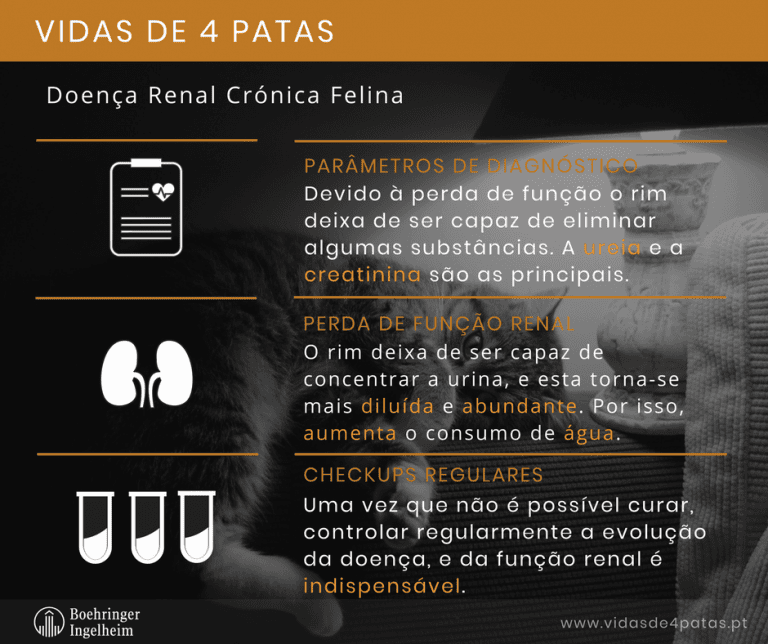
Chronic Kidney Disease is a pathology that affects the kidneys, but is reflected systemically, affected the whole body.
At an early stage some responses from the body occur to try to compensate for the loss of function of this organ. At that point the first symptoms appear. In the specific case of cats, often for a long period of time (months or even years), the symptoms are very subtle and difficult to value by pet owners, which unfortunately causes many to be diagnosed only at advanced stages of Chronic Kidney Disease.
Thus, it is essential to know the most frequent symptoms of Chronic Kidney Disease in order to know what happens.
But what, after all, are the symptoms that a cat with chronic kidney disease can present and that should alert a guardian?
The symptoms may be several, when observing these or some of these behaviors, you should always seek out your assistant veterinarian:
* drinking a lot of water (polydipsia) and increasing daily urine volume (polyuria) – this is one of the most usual symptoms and described by the owners.
* Loss of appetite (some animals present pictures, where they eat less, in a sporadic way, so this aspect is devalued by many owners, being only indicated as significant and worrying when the animal stops eating completely)
* Loss of body condition (weight loss in most cases is slow and the owner, in most cases, cannot have a perception of this symptom right at the beginning of the pathology)
* Vomiting
* Bad breath (halitosis)
* Oral cavity ulcer
* Animals sleep more than usual
* They stop washing
* Hair with spleen and fragile appearance
* Generalised weakness
* Dehydration
* Anaemia
* Hypertension
* Kidney shape and size change
* Protein loss in urine (proteinuria)
* Metabolic acidosis
Many of these symptoms can be detected by the owners, others only through means of clinical diagnosis. There are animals that present all these symptoms and others only a few.
Many of these alterations are not exclusive to Chronic Kidney Disease and may arise in other clinical conditions and other pathologies. The Veterinarian should always be informed of any change detected and will be the most suitable one to make the correct diagnosis.
(Reprinted article from the website of Boehringer Ingelheim Portugal)